


Seminars
Forthcoming Seminars
Prof. Sophie Hatte,
ENS de Lyon
7th October 2026, 15:30(CET)
Link Available Soon

Prof. Nadiya Kostyuk,
Carnegie Mellon University
28th October 2026, 15:00(CET)
Link Available Soon
Dr. Corinne Bara,
ETH Zürich
11th November 2026, 15:00(CET)
Link Available Soon
Past Seminars
Demographic Fingerprints of Armed Conflict: A Clustering Analysis of Age-Sex Mortality Patterns
Michael Spagat
Abstract
Understanding the demographic patterns of death in armed conflicts provides crucial insights into the nature of violence and can inform accountability efforts. This study introduces the concept of a conflict's demographic fingerprint — the full age-sex distribution of deaths across five-year age groups — and employs hierarchical clustering using Hellinger distance to group 20 conflicts spanning the 20th and 21st centuries by the similarity of their fingerprints. The analysis reveals three distinct cluster types. Combatant-skewed conflicts show deaths concentrated among young adult males, consistent with armed groups fighting each other (examples: Colombia, Northern Ireland, Peru). Male-targeted conflicts show elevated male mortality across a wide adult age range, consistent with systematic killing of men regardless of combatant status (examples: Bosnia, Srebrenica, Kosovo). Indiscriminate conflicts show deaths spread broadly across ages and sexes, with substantial proportions of women, children and elderly (examples: Rwanda, Cambodia, El Mozote). The central finding is that Gaza post-October 7 falls within the Indiscriminate cluster alongside Rwanda, Cambodia and El Mozote — cases universally recognised as mass atrocities or genocides. This result is robust across two independent analyses: one based on raw death fractions and a second based on death rates per 100,000 population, which accounts for Gaza's young population structure. Like a fingerprint at a crime scene, demographic cluster membership is evidence rather than a verdict — it does not by itself establish genocidal intent. However, it places Gaza in uncomfortable demographic company and substantially narrows the range of plausible innocent explanations. This approach complements traditional conflict analysis and provides quantitative evidence relevant to international humanitarian law and human rights investigations.
Climate change, cooperation and conflict: Evidence from Bangladesh
Nina von Uexkull, Jan Freihardt, Vally Koubi
Abstract
Climate change is widely framed as a driver of armed conflict. However, this focus overlooks important cooperation and conflict dynamics in settings characterized by relative stability where the majority of climate-vulnerable populations live. Drawing on a multi-wave panel of approximately 1,300 households in 36 villages along the Jamuna River in Bangladesh, we examine how riverine flooding and riverbank erosion relate to cooperation and conflict in a climate-vulnerable context outside zones of organized armed conflict. We find that household-level hazard impacts are consistently associated with higher levels of cooperation both in-group (toward fellow villagers) and out-group (toward strangers from outside the village), particularly in villages where many households are affected. Conflict responses, by contrast, emerge only under specific conditions. Specifically, support for violence rises primarily among those who feel socially excluded or report low levels of generalized trust, highlighting the critical roles of trust and inclusion in shaping resilience to climate-related hazards. Overall, these findings indicate that cooperation rather than conflict is the predominant social response to climate-related hazards in this setting, underscoring the importance of considering cooperative alongside conflictual dynamics in climate–security research.
The Role of Private Enterprises in Sustaining Conflict and Building Peace
Book Description
Private corporations are rarely discussed as playing a role in efforts to curb civil violence, even though they often have strong interests in maintaining stability. Violence often damages the infrastructure necessary to deliver goods to market or may directly target companies. Corporations also have a normative obligation to conduct business in ways that promote peace. While there are historical examples of firm-instigated violence and firms reaping benefits from instability and conflict, there is also evidence that corporations proactively engage in peacebuilding. For example, firms devise programs to promote economic development, offer access to education, and employ former combatants.
In The Building and Breaking of Peace, Molly M. Melin develops a theory of the conflicting roles corporations play in both building and preventing peace. Melin shows that corporations engage in peacebuilding when there is a gap in the state's capacity to enforce laws, but they also weigh the opportunity costs of peacebuilding, responding to the need for action when conditions enable them to do so. Firms are uniquely situated in their ability to raise the cost of violence, and proactive firms can increase the years of peace in a country. At the same time, an active private sector can make it harder for states with ongoing conflict to reach an agreement, as they act as an additional veto player in the bargaining process.
Including original cross-national data of peacebuilding efforts by firms in Latin America, the Middle East, and Africa from 2000 to 2018, and in-depth case analyses of corporate actions and outcomes in Colombia, Northern Ireland, and Tunisia, Melin shows that corporations help to prevent violence but not resolve it. In examining the corporate motives for peacebuilding and the implications of these activities for preventing violence and conflict resolution, the book builds a more holistic picture of the peace and conflict process. The findings also help explain why armed civil conflicts persist despite the multitude of diverse actors working to end them.
Download the full program here
Global Entropy: Restructuring the Post-Liberal World is an international conference hosted by ASERI, in partnership with IPSC, at the Università Cattolica del Sacro Cuore, to be held in Milan on 15–16 April 2026. The event will bring together distinguished scholars and experts from leading universities and research institutions for two days of high-level discussion on the political, economic, and strategic transformations reshaping the contemporary international order. By fostering dialogue across disciplines and perspectives, the conference aims to provide a timely forum for critical reflection on the challenges and uncertainties that define the post-liberal global landscape. Open to both academic and wider interested audiences, the initiative offers an important opportunity for exchange on some of the most pressing issues in international affairs today.
Does Heat Increase the Potential for Peace Events?
Neil T. N. Ferguson and Jennifer Wilhelm
Abstract
Climate change poses an increasing threat to peace. Heat is linked to escalations in conflict and concerns are raised that a warming world could create uncontrollable spirals of violence. While it is tempting to think this also undermines peaceful conflict resolution, theory on transitions out of conflict paints a more nuanced picture. Escalating violence is a predictor of the end of conflict, via military and peaceful means. Higher violence could increase the “hurting” of a stalemate and could draw the attention of the international community, encouraging peace events. Disaster diplomacy suggests renewed attention and aid could be drawn to conflict settings, increasing efforts towards peace. Yet, it is also intuitive why escalating violence might undermine potential peace events. Noting this ambiguity, we test the impact of the exogenous onset of El Niño and La Niña on the number of on-going peace events – specifically, negotiation and mediation processes. We show that El Niño is correlated with an increased number of peace events and La Niña with a reduction. Additional analyses show that these effects are not driven, solely, by escalating violence and are not, simply, the outcome of an increased number of conflicts. This suggests that heat plays a specific role in determining peace events, like negotiations and mediations. While escalating conflict in a warming world remains a risk, efforts to resolve these conflicts peacefully are not fatally undermined.
Grazia Pacillo, CGIAR
Measuring the Climate–Conflict Nexus:
Where We Go Wrong and How to Fix It
Watch the full webinar recording here.
Prof. Sarah Langlotz, University of Göttingen
When risk and rescue matter: Irregular migration across origin and transit
Abstract
This paper examines how migration risk shapes irregular migration across origin and transit. We focus on how sea-crossing risk and rescue affect migration intentions in origin countries and departure dynamics during transit on the Central Mediterranean route. We combine an information experiment in Nigeria with high-frequency, geo-referenced data on irregular departures and NGO rescue operations. At the origin, our experiment shows that rescue-induced changes in perceived crossing risk do not affect irregular migration intentions. Exploiting exogenous variation in NGO rescue availability, we find that greater rescue presence increases same-day departures, consistent with smugglers competing by offering relatively safer passage to Europe.

DEMOCRAZIA E PACE. Presentazione della terza rilevazione dell'Osservatorio sullo stato della democrazia Polidemos-Ipsos
Speakers:
Damiano Palano, Direttore Polidemos
Andrea Scavo, Direttore Public Affairs IPSOS-DOXA
Nicoletta Alessi, Fondatrice e Presidente Goodpoint
Raul Caruso, Direttore International Peace Science Center
Rossella Sobrero, Presidente Koinètica
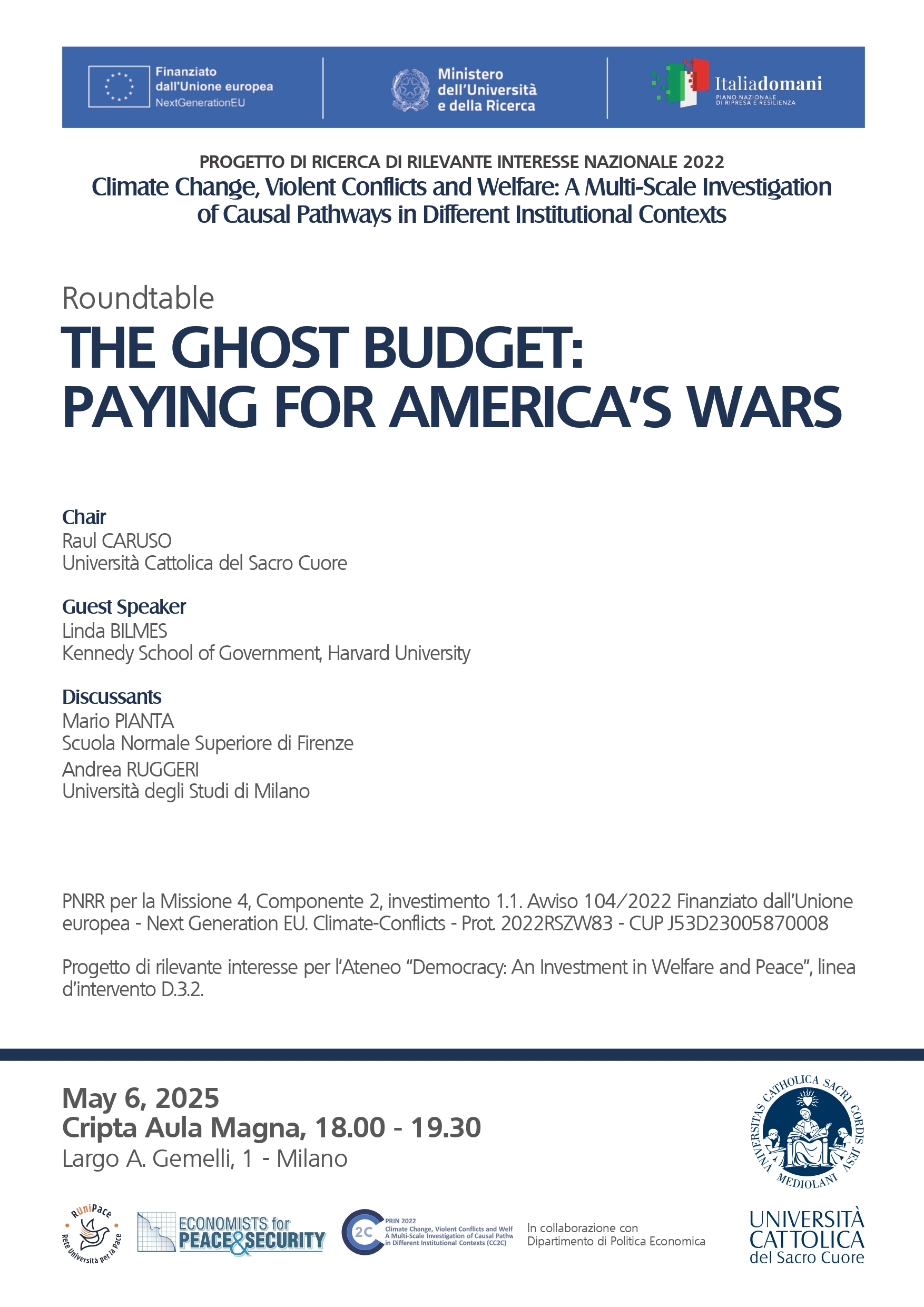
Roundtable
THE GOST BUDGET: PAYING FOR AMERICA'S WARS
Chair: Raul Caruso, Università Cattolica del Sacro Cuore
Guest Speaker: Linda J. Bilmes, Kennedy School of Government, Harvard University
Discussants:
Mario Pianta, Scuola Normale Superiore di Firenze
Andrea Ruggeri, Università degli Studi di Milano
