PsyMe App

PsyMe is a free app created to support scientific research in the field of social psychology and artificial intelligence. It was born from the collaboration between the University of Pavia and the Catholic University of the Sacred Heart of Milan.

With PsyMe, you can participate as a volunteer in scientific research.

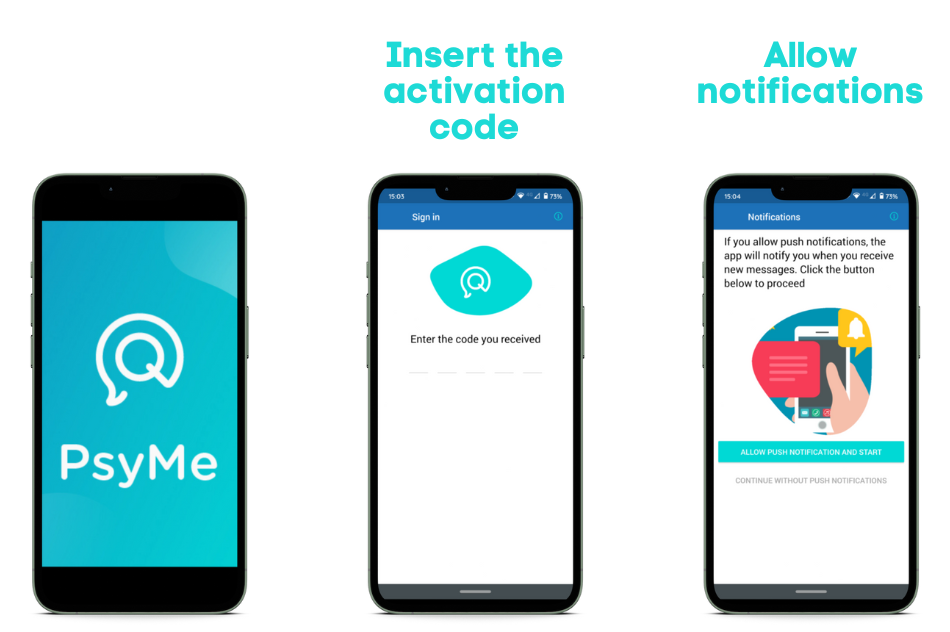
To do so, you need a unique and anonymous code provided by the researchers to be entered in the app. After doing this:

  • PsyMe App will send you a first questionnaire;
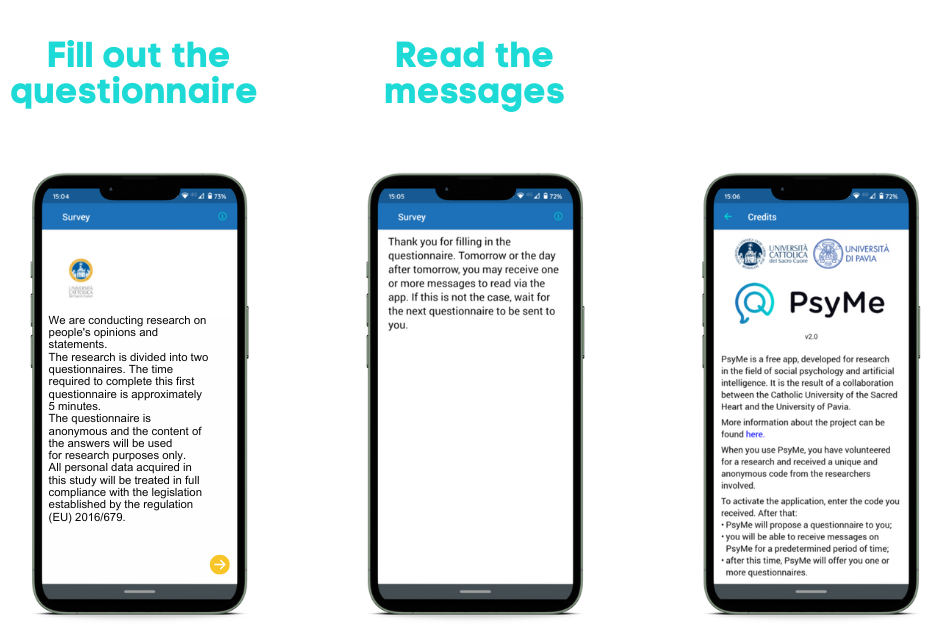
  • after a couple of days you could receive some messages on PsyMe for a set period of time;
  • at the end, PsyMe App will send you a second questionnaire.

Once you have completed the second questionnaire, your participation in the research will end and the app will return to a passive state. You can activate it again by entering in the app a new code for another research.

Esempi schermate app

PsyMe has been designed to respect your privacy and anonymity. You will not be asked to provide us your name, your phone number, or your email. You will receive messages anonymously and you will not be asked for any data other than the questionnaires.

PsyMe is available for iOS and Android:

Apple Store
Google Play Store

Research with PsyMe App

Gaetani, M., Carfora, V., Picciafoco, L., & Catellani, P. (2026). Testing Motivational Appeals to Promote Legume-Enriched Foods. Nutrients, 18(4), 552.

Read the article

Catellani, P., & Piastra, M. (2025). Promoting physical activity in middle-aged and older adults through digital intervention: matching message frame and recipient profile through deep reinforcement learning. Cogent Psychology, 12(1), 2541720.

Read the article

Vezzoli, M., Carfora, V., & Catellani, P. (2025). Communication Intervention to Improve Young Adults’ Food Safety Practices: The Benefits of Using Congruent Framing. Nutrients, 17(5), 928.

Read the article

Carfora, V. & Catellani, P. (2024). Environmental messages to promote sustainable seafood choices: An explorative mobile app intervention. Journal of Environmental Psychology, 94, 102255.

Read the article

Catellani, P., Carfora, V., Biella, M. Brischigiaro, L., Manera, M., Nardone, A., & Piastra M. (2023). A theory-based and data-driven approach to promoting physical activity through message-based interventions. Frontiers in Psychology, 14, 1200304.

Read the article

Carfora, V., & Catellani, P. (2022). Legumes or meat? The effectiveness of recommendation messages towards a plant-based diet depends on people’s identification with flexitarians. Nutrients, 15(1), 15.

Read the article

Carfora, V., & Catellani, P. (2022). Advertising innovative sustainable fashion: Informational, transformational, or sustainability appeal?. Sustainability, 14(23), 16148.

Read the article

Carfora, V., Biella, M., & Catellani, P. (2022). Affective components in promoting physical activity: A randomized controlled trial of message framing. Frontiers in Psychology, 5073. 

Read the article

Carfora V., Morandi M., & Catellani P. (2022). The influence of message framing on consumers’ selection of local food. Foods, 11(9), 1268. 

Read the article

Carfora, V. & Catellani, P. (2021). The effect of persuasive messages in promoting home-based physical activity during COVID-19 pandemic. Frontiers in Psychology, 12, 644050.

Read the article

Catellani, P., Carfora, V., & Piastra (2021). Connecting social psychology and deep reinforcement learning: A probabilistic predictor on the intention to do home-based physical activity after message exposure. Frontiers in Psychology, 12, 696770.

Read the article

Privacy Notice for the Processing of Personal Data – PsyMe App (Last updated: July 2026)

1. Introduction

The PsyMe app is used within research projects promoted by the PsyLab Research Center of Università Cattolica del Sacro Cuore. For general information on the University's processing of personal data, please refer to the University's Privacy Policy, available at: www.unicatt.it/privacy.html

2. Identity and Contact Details of the Data Controller

The Data Controller of your personal data is Università Cattolica del Sacro Cuore (hereinafter also referred to as the “Data Controller”), with registered office at Largo Agostino Gemelli 1, 20123 Milan, Italy, tel. (+39) 02 7234.1.

3. Categories of Personal Data, Purpose of Processing, and Legal Basis

The data collected through PsyMe are used exclusively for scientific research purposes. Use of the app does not necessarily require the collection of directly identifying information such as telephone numbers, email addresses, or other personal contact details.

Each participant is assigned a unique individual code that allows questionnaire responses to be linked to the relevant research project. The code may be generated automatically by the app or, in specific research projects, assigned directly to the participant by the research team.

In all cases, participation in the research project takes place only after informed consent has been obtained and, where required, consent for the processing of personal data has also been obtained.

5. Methods of Processing

The data collected through PsyMe are stored together with the participant's unique individual code.

• When the research team does not possess information enabling the code to be linked to the participant's identity, the data are processed anonymously.

• When, for specific project requirements, the code is assigned directly to the participant and can therefore be linked to their identity, the data are processed in a pseudonymized or semi-anonymized form, in accordance with the information notice and informed consent relating to the specific research project.

6. Data Retention Period

The data are stored on the information systems of Università Cattolica del Sacro Cuore for the period necessary to conduct the research projects and the subsequent analysis, reporting, and scientific publication activities, in compliance with applicable legislation and the information provided to participants.

7. Categories of Recipients to Whom the Data May Be Disclosed

Your data may be disclosed to:

• Public and private bodies or competent authorities, in order to comply with legal or regulatory obligations and to enable the implementation of the research project;

• Companies and/or professionals providing app maintenance services;

• The University of Pavia, Department of Industrial and Information Engineering, which is responsible for the technical and scientific coordination of the design and development of the app.

Recipients belonging to the above categories will process the data either as Data Processors formally appointed by the Data Controller in accordance with applicable law or as independent Data Controllers, as appropriate. The list of appointed Data Processors is continuously updated and available at the University's premises.

8. Transfer of Personal Data Outside the European Union

Personal data may be transferred to countries outside the European Union, particularly where services are located outside the EU (e.g., cloud storage services). In such cases, the Data Controller ensures that any transfer is carried out in accordance with the applicable legal provisions.

9. Data Protection Officer (DPO)

The University has appointed a Data Protection Officer (DPO), who can be contacted at: dpo@unicatt.it.

10. Data Subject Rights

As a data subject, you have the right to:

a. Request access to your personal data, erasure of your data, rectification of inaccurate data, completion of incomplete data, and restriction of processing in the cases provided for by Article 18 of the GDPR;

b. Where the conditions for the right to data portability under Article 20 of the GDPR are met, receive the data you have provided to the Data Controller in a structured, commonly used, machine-readable format and, where technically feasible, transmit those data to another controller without hindrance;

c. Withdraw your consent at any time;

d. Lodge a complaint with the competent supervisory authority (the Italian Data Protection Authority).

Where applicable, participants may request the deletion of the data and questionnaires associated with their participation by providing the unique individual code assigned to them. This code is necessary to enable the research team to identify the relevant data and proceed with deletion.

Without the individual code, it may not be possible to identify the data to be deleted, particularly where the data were collected without directly identifying information.

Requests for deletion or clarification regarding data collected through PsyMe may be sent to: psyme@unicatt.it or to the contact details of the principal investigator responsible for the relevant research project.