Beatrice Nicolini
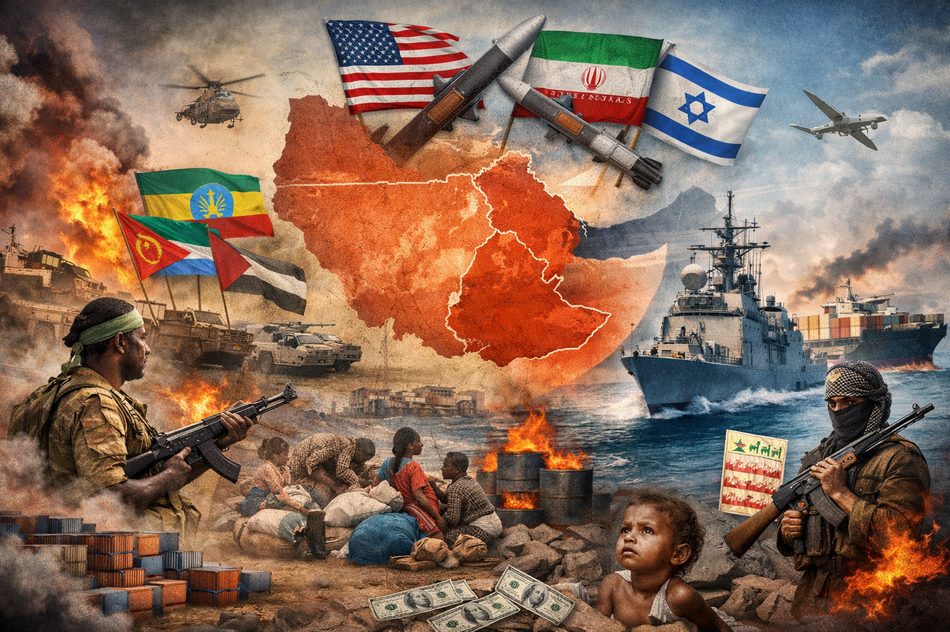
Recent analyses indicate that the Horn of Africa is entering a phase of heightened systemic instability, driven by the intersection of local conflicts and broader geopolitical rivalries. This short reflection integrates reporting on the risk of renewed war in northern Ethiopia with a wider assessment of how the Iran–U.S.–Israel confrontation is reshaping the region. It argues that overlapping alliances, external interventions, and structural vulnerabilities are transforming the Horn into a potential arena of interconnected conflicts with significant humanitarian and global implications.
The Horn of Africa has long been characterized by fragile state structures, unresolved territorial disputes, and complex regional rivalries. However, recent developments suggest a qualitative shift: rather than isolated crises, the region is increasingly defined by interlinked conflict systems. An analysis by The New Humanitarian warns that renewed war in northern Ethiopia could trigger a “regional mega-war” by drawing in Sudan, Eritrea, and external actors. When this dynamic is considered alongside the broader geopolitical tensions linked to the Iran–U.S.–Israel confrontation, the Horn emerges as a critical zone where local conflicts and global rivalries converge.
The immediate risk of escalation stems from northern Ethiopia. After the 2020–2022 Tigray war, tensions between the federal government, Tigrayan factions, and Eritrea have resurfaced. Ethiopia’s renewed military posture, coupled with its ambition to secure access to the Red Sea, has sharply deteriorated relations with Eritrea. At the same time, Sudan’s ongoing civil war has created a volatile environment of competing alliances.
The Sudanese Armed Forces (SAF) have strengthened ties with Eritrea and Tigrayan actors, while Ethiopia is reportedly linked to the rival Rapid Support Forces (RSF). This configuration produces what analysts describe as a “one-conflict ecosystem”, where distinct wars risk merging into a broader regional confrontation. Crucially, the involvement of non-state actors and cross-border militias, particularly in eastern Sudan, further lowers the threshold for escalation. Conflict diffusion may therefore occur not only through state decisions but also through localized mobilization networks with transnational ties.
Overlaying these regional dynamics is the expanding influence of Middle Eastern rivalries. The Horn of Africa is increasingly exposed to the spillover effects of the Iran–U.S.–Israel confrontation, with consequences that are geopolitical, security-related, and socio-economic. At the geopolitical level, global attention is shifting toward the Middle East, potentially reducing diplomatic engagement in the Horn. This risks leaving conflicts in Ethiopia, Sudan, and Somalia more prone to escalation.
Simultaneously, Iran may seek to expand its influence through proxy relationships in fragile states, while other actors — including Israel, Türkiye, Egypt, and Gulf countries — intensify competition for strategic footholds. As a result, smaller states such as Djibouti, Eritrea, and Somalia face growing pressure to abandon neutrality, leading to realignments that could fundamentally alter the regional balance of power.
The Red Sea constitutes the central axis where regional and global dynamics intersect. Ethiopia’s aspiration for maritime access, Eritrea’s strategic positioning, and Gulf investments in port infrastructure already make the littorals of this East African region highly strategic. The Iran-linked threat environment, particularly through actors such as the Houthis, has accelerated the militarization of maritime routes. Disruptions to shipping, including rerouting around the Cape of Good Hope, indicate a structural transformation of global trade patterns rather than a temporary crisis.
Moreover, the potential expansion of Iranian networks into the Horn raises the prospect of hybrid threats. Possible linkages with groups such as Al-Shabaab could generate a complex security landscape combining terrorism, piracy, and illicit trafficking. In this context, any escalation between Ethiopia and Eritrea would not remain localized but would directly affect one of the world’s most critical maritime corridors.
The economic consequences of these dynamics are severe. The Horn of Africa is heavily dependent on maritime trade and external supply chains, making it particularly vulnerable to Red Sea disruptions. Rising transport and insurance costs, declining port activity, and supply chain interruptions are already exerting pressure on both coastal and landlocked economies. Inflation, especially in fuel and food, erodes purchasing power and exacerbates fiscal imbalances.
Governments face a dual constraint: declining revenues and increasing expenditure needs. This combination is likely to deepen reliance on external debt and increase the risk of prolonged economic stagnation or crisis. Economic stress feeds directly into social instability. In a region already affected by displacement, food insecurity, and weak governance, rising living costs and unemployment intensify public discontent.
The humanitarian baseline is already critical. The Tigray war caused massive civilian suffering and long-term disruption, while Sudan is currently experiencing one of the largest humanitarian crises globally, with millions displaced and widespread food insecurity. In such conditions, renewed conflict would not simply add new pressures but would compound existing vulnerabilities, accelerating institutional erosion and increasing the likelihood of widespread unrest.
The convergence of these factors explains why analysts warn of a potential “regional mega-war”. Three structural conditions underpin this risk: interconnected conflicts linking Ethiopia, Sudan, and Eritrea through overlapping alliances; external intervention by Gulf states and other powers, often backing opposing sides; and strategic geography, with control over Red Sea access amplifying the stakes of local conflicts. When combined with the broader Iran–U.S.–Israel confrontation, these dynamics create a multi-layered conflict system in which escalation in one arena can rapidly propagate across others.
The Horn of Africa is undergoing a transformation from a set of discrete crises into a highly interconnected strategic theater. Local tensions, particularly in northern Ethiopia, are increasingly embedded within wider geopolitical rivalries and maritime security concerns. Without coordinated diplomatic, security, and economic responses, the region risks entering a prolonged phase of instability characterized by intensified great-power competition, persistent insecurity in the Red Sea, and deepening economic fragility. Such an outcome would not only have devastating consequences for local populations but would also carry significant global repercussions, given the Horn’s centrality to international trade and security.
Beatrice Nicolini is a full professor of African history. She teaches African History and Institutions; Religions, Conflicts, and Slavery; and The Indian Ocean World at Università Cattolica del Sacro Cuore.